


which grade of titanium is best depends on the application rather than a universal ranking. Grade 2 can suit projects that prioritize corrosion resistance and formability, while Grade 5 may be considered when higher strength is required.
The choice also depends on service conditions and specifications. Buyers can compare titanium grade 2 in Italy, titanium grade 2 in France, and titanium grade 2 in the UK according to project requirements.
This guide compares common grades and explains how to make a reliable selection before purchasing titanium.

What Makes One Titanium Grade More Suitable Than Another?
Titanium grades are not interchangeable. Commercially pure and alloyed grades provide combinations of strength, corrosion resistance, formability, and fabrication characteristics.
Important factors include:
· Corrosion resistance and chemical exposure
· Mechanical strength and fatigue requirements
· Weight and strength-to-weight performance
· Forming, machining, and welding requirements
· Operating temperature and service environment
· Applicable specifications and certification
· Product form, dimensions, and availability
Titanium grade selection should start with the component conditions.
Is Grade 2 Always the Best Titanium Grade?
No. For this application, which grade of titanium is best should be assessed first. Grade 2 is a commercially pure titanium grade with a useful balance of corrosion resistance, moderate mechanical properties, and formability.
It can be relevant to chemical processing, marine service, and other applications where corrosion performance matters. The best titanium grade is therefore application-specific.
Grade 5, commonly known as Ti-6Al-4V, provides substantially higher strength for demanding structural components. However, greater strength does not automatically mean it is the right material. Fabrication, corrosion conditions, specifications, and procurement requirements may lead to another choice.
A practical titanium grade comparison considers the complete property profile rather than one strength value.
Common Titanium Grades at a Glance
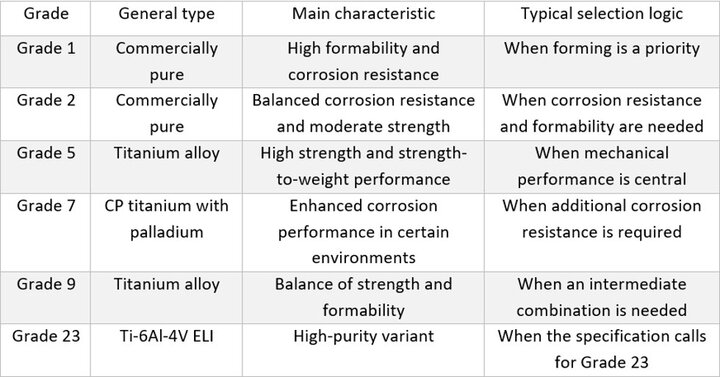
Common Titanium Grades at a Glance
This table shows why the best grade of titanium depends on the component requirements.
Where Does Titanium Grade 2 Fit?
Grade 2 is often selected when corrosion resistance is important and extreme strength is not the primary design requirement. Its properties can also make fabrication practical for many components.
For procurement teams, a titanium grade comparison is one part of the evaluation. Buyers may need to verify the specification, dimensions, batch identification, test reports, certification, and traceability.
Material traceability is especially important for industrial projects. Clear documentation supports receiving inspection, quality control, and later verification of the material used in a component.
Which Grade of Titanium Is Best for Different Industries?
Industry requirements can change the suitable grade.
Aerospace and High-Performance Components
Aerospace components can emphasize low weight, mechanical performance, qualification, specifications, and traceability. Grade 5 may be considered where high strength is central, while other components may require different grades or specifications.
The decision should follow the engineering specification.
Oil & Gas and Process Equipment
Process equipment may face aggressive chemicals, elevated temperatures, pressure, and demanding fabrication conditions. Grade 2 can be relevant when its corrosion resistance and mechanical profile match the service environment. Grade 7 may also be considered for certain corrosive conditions.
Medium, concentration, temperature, pressure, and applicable standards should be reviewed before confirmation.
Marine Applications
Marine service can make corrosion resistance a major consideration. Titanium may be suitable for selected components exposed to seawater or other corrosive conditions, but the actual service environment, mechanical loads, fabrication method, and project specification still need review.
Energy and Industrial Manufacturing
Industrial projects can combine mechanical, corrosion, fabrication, and documentation requirements. The selected titanium grade should satisfy the technical requirement without unnecessary material or procurement constraints.
A Practical Titanium Grade Selection Process
Rather than starting with a grade name, engineers and buyers can follow these steps:
1. Define the operating environment: Identify corrosion exposure, temperature, pressure, and other service conditions.
2. Set mechanical requirements: Determine strength, ductility, fatigue, and weight requirements.
3. Review fabrication needs: Consider forming, machining, welding, heat treatment, and component geometry.
4. Check project specifications: Confirm whether a code, customer requirement, or approved material list limits acceptable grades.
5. Verify documentation: Review certification, testing, heat numbers, dimensions, and traceability.
6. Compare supply options: Check product form, dimensions, lead time, and availability after technical requirements are established.
This process turns the question "which grade of titanium is best" into a structured procurement decision. It also helps determine which titanium grade is best for the actual service conditions.
Why Documentation Matters Alongside Grade Selection
A material certificate should establish material identity and conformity. Alloy360 describes its VANTAGE program as including document review, physical verification, and independent third-party inspection before shipment.
Its published process includes checking material certificates against applicable specifications, PMI testing, visual inspection, dimensional and quantity checks, and photographic or video documentation. Third-party verification may also involve organizations such as SGS, TÜV, or Bureau Veritas.
For demanding procurement, certified material and full traceability can reduce uncertainty by connecting material with inspection records.
Alloy360 states that it supplies titanium, nickel alloys, stainless steel, and alloy steels to OEMs, EPCs, and manufacturers in sectors including aerospace, oil and gas, marine, and energy. Its procurement information emphasizes traceability and engineering-focused support.
Choosing Titanium by Requirement, Not Reputation
The answer to which grade of titanium is best depends on the specific engineering requirement. Grade 2 suits applications requiring corrosion resistance and formability, while Grade 5 is considered when higher strength is needed. Grades 7, 9, and 23 may meet other technical requirements.
Before ordering, buyers should confirm the grade, dimensions, product form, certification, and specifications. This applies to sourcing titanium grade 2 in Italy, titanium grade 2 in France, or titanium grade 2 in the UK.
Have a specific titanium grade, specification, or application in mind? Share the requirement or question you are working with, then use the Alloy360 site as a reference point for reviewing the available material and documentation options before moving forward with a purchase.
Final Takeaway
Before choosing a titanium grade, ask which combination of corrosion resistance, strength, formability, specification, documentation, and availability the application requires. Grade 2 and Grade 5 serve different purposes, so the best grade of titanium may differ according to the project. Other grades can also be appropriate when a project calls for a different balance.
Have a specific titanium grade, specification, or application in mind? Share the requirement with the supplier and review the available material and documentation options before moving forward with a purchase.
This article is an advertisement and Mehr News Agency has no opinion on its content.

دیدگاه