


It is for years that the United States has imposed tough restrictions and sanctions on some countries, and justifying its own foreign policy under the banner of spreading democracy, claiming to be the champion of freedom and popular sovereignty. Yet, an examination of the US electoral structure reveals that, even within the United States itself, there exists a significant gap between the formal equality of citizens and their actual power to influence policy.
In the United States, every citizen has one vote, yet not all citizens possess equal power to shape the electoral landscape. While millions of people head to the polls to elect their representatives, billionaires, large corporations, and economic groups, by injecting billions of dollars into political contests, play a pivotal role in setting the electoral agenda, managing advertising, and elevating specific candidates. The issue goes beyond mere high campaign costs; it concerns how wealth is converted into political power and the extent to which this can undermine the principle of equal sovereignty among the people.
Billionaires: The Key Players Behind the Scenes of US Elections
The 2026 US midterm elections serve as a clear example of this situation. According to an October 27 report by the American organization "Public Citizen," more than 500 donors, each contributing at least $1 million to Super PACs (Independent expenditure-only political action committees), have collectively allocated approximately $4.2 billion to these committees; a figure that accounts for over 70 percent of the funds raised by them.
In the same report, Elon Musk’s financial contributions to super PACs for the 2026 election cycle are estimated at approximately $445 million. Thus, a single billionaire possesses vast financial resources to support his preferred candidates and political movements—a capacity that is essentially unimaginable for an ordinary citizen.
The significance of these figures lies not merely in their magnitude. Vast financial resources can be used to establish advertising networks, disseminate campaign messages on a massive scale, and boost the visibility of candidates backed by the wealthy. Under such circumstances, while citizens’ votes are still counted on the election day, the wealthy have already spent months shaping the environment in which voters make their decisions.
This influence is not limited to a single party. According to an analysis by the Brennan Center for Justice, the 40 largest donors to the 2026 midterm elections had contributed over $2.4 billion to political contests by mid-October. This figure alone is more than 50 percent higher—even after adjusting for inflation—than the combined contributions from the largest financial backers during the entire 2022 midterm election cycle. Thus, the issue is not merely the financial support of Republicans or Democrats; rather, it is the structural influence wielded by holders of capital on both sides of the political divide.
Large-scale Corporations: Investing for Political Influence
Other dimensions of this problem are revealed in the spending of large companies. According to an Oct. 29 report by Public Citizen, registered contributions from for-profit corporations to super PACS and political committees related to the 2026 federal election totaled about $737.3 million; A figure that is 60% more than what the companies spent in the 2024 presidential election.
Among economic sectors, companies operating in the fields of cryptocurrency, online betting, and Big Tech—particularly those involved in artificial intelligence and data centers—have collectively contributed approximately $391 million to election campaigns. A single Super PAC aligned with the Trump political movement has received about $141 million of these recorded corporate contributions.
These figures indicate that corporations are not merely passive observers of the election. Decisions made by the administration and Congress regarding taxes, technology regulations, the cryptocurrency market, energy, and government contracts can directly impact their economic interests. Consequently, the significant presence of corporate funds in the election should be viewed as an effort to influence public policy.
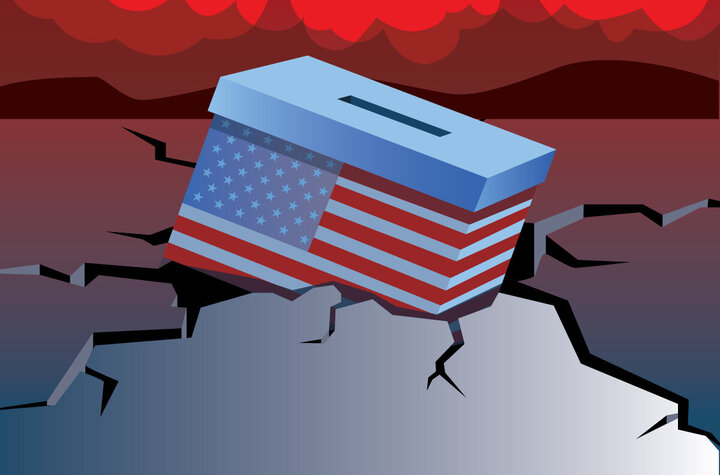
Super PACs: The Legal Mechanism for Converting Wealth into Influence
One of the most significant instruments in this process is the type of committee known as a "Super PAC." Under US Federal Election Commission regulations, these committees may accept unlimited contributions from individuals, corporations, and unions, and spend these funds on independent advertising to support or oppose candidates—provided that such expenditures are not coordinated with the candidate or their campaign.
The expansion of this mechanism traces back to the 2010 US Supreme Court ruling in the *Citizens United* case—a decision that struck down previous restrictions on independent spending by corporations and unions in connection with federal elections. Subsequently, the "Super PAC" mechanism paved the way for the infusion of vast financial resources into political contests.
The impact of this trend is also evident in election advertising expenditures. According to data from the ad-tracking firm AdImpact, the total value of advertisements purchased and reserved for the 2025 and 2026 election cycles had surpassed $11.21 billion as of October 27—a figure that exceeds the total advertising spend for the 2024 presidential election cycle. This amount pertains exclusively to advertising and does not encompass costs such as field organizing, staff salaries, or other campaign-related activities.
Democracy for Others, Challenges at Home
The primary contradiction becomes apparent when this situation is viewed alongside US foreign policy. Washington has frequently invoked democracy, human rights, and political freedoms as a basis for evaluating other governments; in some instances, it has employed targeted sanctions and other forms of economic pressure, citing these very justifications. Iran, Cuba, Nicaragua, and several other nations are subject to US sanctions regimes—measures that are, in part, predicated on political and human rights-related concerns.
Of course, not all US sanctions are imposed in the name of democracy; Washington also cites other reasons for them, such as national security, nuclear issues, or the fight against terrorism. Nevertheless, democracy and human rights remain key instruments within the discourse of U.S. foreign policy.
But can a country where economic power exerts such extensive influence over political competition evaluate others by democratic standards, without first examining its own internal problems?
This question gains even greater significance when international reports also point to democratic challenges within the United States. According to a 2026 report by Freedom House, the US score on the global freedom index has declined from 84 the previous year to 81 out of 100. The report identifies factors such as deepening political polarization, the growing influence of money in politics, and functional issues within government institutions as key challenges facing American democracy.
Furthermore, in an April 2026 report—which examined indicators from Freedom House, the V-Dem Institute, and the Economist Intelligence Unit—the Pew Research Center stated that all three assessments point to a weakening of the state of democracy in the United States in 2025. According to V-Dem data, the US score on the Liberal Democracy Index has reached 0.57 out of 1, marking its lowest level since 1965. Additionally, the Economist Intelligence Unit has categorized the United States as a "flawed democracy" in its 2025 Democracy Index.
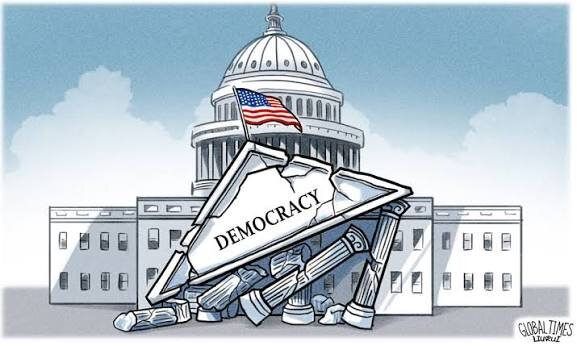
Conclusion
The core issue in critiquing American democracy is not that citizens lack the right to vote or that elections are not held; rather, it concerns the inequality in actual power to influence the political process. When an ordinary citizen participates in an election with a single vote, while a billionaire can spend hundreds of millions of dollars on advertising and supporting candidates, one cannot claim that political equality exists simply because the ballot box is present.
Democracy is not merely about holding elections; it also depends on citizens having equal opportunities to participate in shaping their political destiny. From this perspective, the American electoral structure faces serious questions regarding the role of the wealthy, the influence of corporations, and the accountability of decision-makers.
Washington cannot, on the one hand, make democracy a benchmark for evaluating other nations while, on the other hand, ignoring the structural challenges within its own political system. Before calling upon others to uphold democratic standards, the United States must address this question: in a country where billions of dollars in capital shape electoral contests, to what extent is the equal will of citizens the true basis for political decision-making?
MNA

دیدگاه